 DPDPA Compliance Training
Why workforce awareness training is a different product from an individual certificate course.
Free and paid DPDP certificate courses are appearing across the Indian market — designed for individuals building expertise. Workforce awareness training solves a different problem. If your organisation needs every employee trained before the enforcement deadline, here's why the two aren't substitutes.
Two different problems, two different products
A certificate course is designed for one person at a time — a compliance officer building expertise, a DPO preparing to run a programme, a professional wanting a credential to display. It's long, it's deep, and it ends with an individual name on an individual certificate. That's the right shape for individual learning.
Workforce awareness training solves a different problem: getting every employee — the clerk, the sales executive, the warehouse supervisor, the customer-facing officer — through organisation-wide DPDP awareness within a working day, with centralised, audit-ready records the compliance team can produce on request. The two products aren't in the same category. Choosing between them isn't a trade-off — it's a decision about which job your organisation is actually trying to do.
What each is built for
| Individual certificate course | Workforce awareness training | |
|---|---|---|
| Audience | An individual professional building expertise | Every employee in an organisation |
| Focus | Depth in the law and its application | Behavioural recognition and response |
| Duration | Multiple hours, often 3+ hours of content | Sixty minutes, designed to fit into a working day |
| Enrolment | Self-driven by the individual learner | Enrolled and tracked by the organisation |
| Records | Certificate issued to the individual | Admin dashboard with per-learner records, exportable for audit |
| Cost model | Priced for individual learners | Priced per learner, quoted to the organisation |
The four problems awareness training is designed to solve
When an organisation needs its whole workforce trained on schedule with records to prove it, the specific problems that need solving are different from the ones an individual learner faces. Workforce awareness training is built around four of them.
1. Getting every employee across the line, on schedule
Workforce training is designed to fit into a normal working day. The Abhisam course is modular — employees can complete the whole course in one hour-long sitting, or take one module at a time and finish across the week, whichever fits their schedule. It runs on a laptop, a desktop, a tablet, or an iPad — so an employee travelling, working from home, or moving between shifts can complete it without needing special arrangements. A course that adapts to how employees actually work is a much easier "yes" when a compliance auditor asks whether every employee completed DPDP training on time.
Want to see how the course plays for a learner? Book a demo — we'll walk you through a module and answer specific questions about how it would fit your workforce.
2. Centralised, exportable evidence for auditors
Workforce training platforms produce more than a completion tick-box. The Abhisam admin dashboard captures every learner interaction — which modules they opened, how much time they spent on each, when they resumed after a break, the score on every knowledge check and drag-and-drop exercise. If a compliance auditor or the Data Protection Board asks your organisation to demonstrate that all 100 employees completed DPDP training — and how thoroughly — the answer isn't a bare "yes." It's a detailed record of the actual engagement. That record exports to XLS or CSV, but it isn't a simple spreadsheet — it's an audit trail. Individual certificate courses are built around the certificate the learner receives — perfect for the learner, but not designed as an audit-ready workforce record.
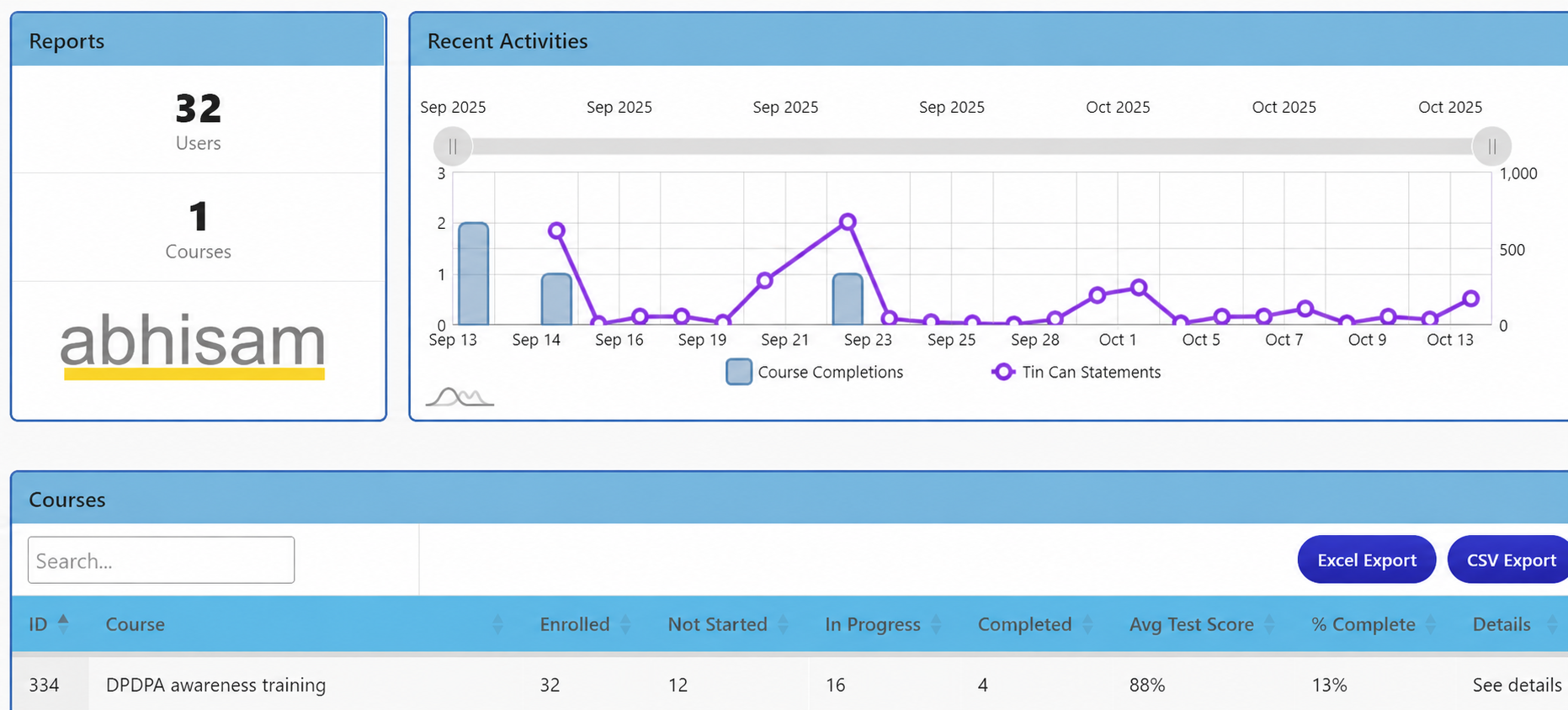
This is the main dashboard view. Multiple drill-down views show every module a learner opened, the time spent on each, the resume pattern across sessions, and the score on each interaction — exactly what an auditor would ask to see. Book a demo to walk through them.
3. Employee time cost
A course designed to fit into a single working session is a fraction of the time cost of a multi-hour programme, multiplied across every employee in an organisation. For an SME watching every operating expense, that difference matters — and it matters more, not less, at organisations where employees are already stretched thin.
4. Content calibrated to the audience
Workforce training focuses on the situations a general employee actually encounters: recognising a suspected incident, spotting a Data Principal request in an ordinary email, knowing what to route to the compliance team. Individual courses often go deeper into legal analysis and framework design — appropriate for a compliance professional building expertise, but more than what's needed for organisation-wide awareness.
Certificate courses have their place
Certificate courses aren't a competitor to workforce training — they're a different tool for a different job. If a specific individual in your organisation needs deep DPDP expertise — your DPO, your compliance lead, a specialist building the programme — a certificate course is exactly the right tool for that person. Many organisations need both: workforce training for every employee, individual upskilling for the small number of people who need depth. The two products work well side by side; they solve different problems.
Making the decision
The test is straightforward. If you need to train dozens or hundreds of employees, and your compliance team needs centralised records they can hand to an auditor — workforce awareness training is what you need. If a specific person in the organisation needs deep DPDP expertise, that's a separate purchase for that individual. Most organisations end up needing both. The two products aren't in competition — they serve different jobs.